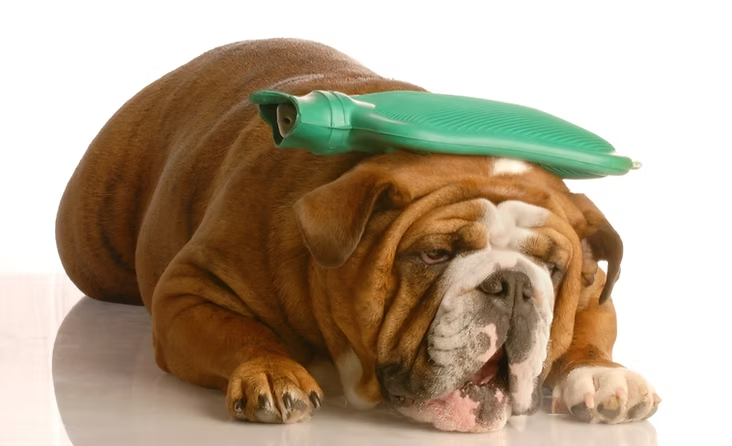
Most of my patients can't tell me what's wrong. A dog with a skin condition, a cat that's stopped eating, a rabbit that just seems "off" — they can't describe their symptoms, so I have to read the visual clues and figure it out from what I can observe. That process — pattern recognition from photos and physical signs — is something I've done thousands of times. It becomes second nature after a while.
What most people don't know about me is that outside of the clinic, I genuinely enjoy building things. Websites, apps, tools — anything where I can take a problem and engineer a solution. I've been a hobbyist developer for years alongside my veterinary career, and I find the two pursuits scratch a similar itch: both are about identifying a problem accurately and fixing it with the right intervention.
Last year I was standing in my backyard staring at a dead patch of grass that had appeared overnight. It was circular, the edges looked slightly darker than the center, and it hadn't responded to extra watering. I did what everyone does and started Googling. An hour later I had 15 different possible explanations, zero confidence in any of them, and a growing suspicion that the generic advice I was reading was written by people who had never actually looked at a lawn.
It struck me that I diagnose diseases from photos and symptoms for a living — and yet no one had applied that approach to lawn care. There was nothing that looked at your actual lawn, in your actual location, in the current season, and told you what was actually wrong.
So I built it.
Introducing GrassDx
🌿 GrassDx — Free AI Lawn Diagnosis
Upload one to four photos of your lawn, enter your ZIP code, and get a diagnosis and treatment plan tailored to your grass type, climate zone, and current season. About 30 seconds. Completely free. No account required.
- 47+ conditions identified
- Fungal diseases, pest damage, nutrient deficiencies, drought stress, weeds
- DIY treatment steps with product recommendations
- Local professional referrals if needed
The ZIP code piece matters more than it might seem. Brown patch fungus looks identical in a Seattle lawn and a Houston lawn, but the cause, the timing, and the treatment are completely different. A diagnosis that doesn't know where you are and what time of year it is isn't much of a diagnosis. GrassDx knows the difference, because I built the clinical reasoning that underlies it the same way I approach a patient: start with what you can see, then factor in the context.
Why a Veterinarian Built a Lawn Tool
I get this question a lot, and the honest answer is that the diagnostic methodology is the same. In veterinary medicine, we're trained to look at a patient systematically: what do we observe, what does the history tell us, what are the most likely differentials given this presentation in this patient at this time of year? Lawn care has exactly the same structure — if you apply it correctly.
The problem is that most lawn care advice online is not diagnostic at all. It's generic, it ignores location and timing, and it treats every lawn the same. I'm a believer that expertise transfers. The clinical reasoning I've developed over my career is genuinely useful outside of medicine, and GrassDx is my attempt to put that to work for something a lot of people struggle with and no one has solved particularly well.
If you've got a lawn problem you can't figure out, give it a try. It's free, it takes 30 seconds, and at worst you'll have a more informed starting point than another hour of Googling.
And yes, my own lawn still has a moss problem. The cobbler's children have no shoes.